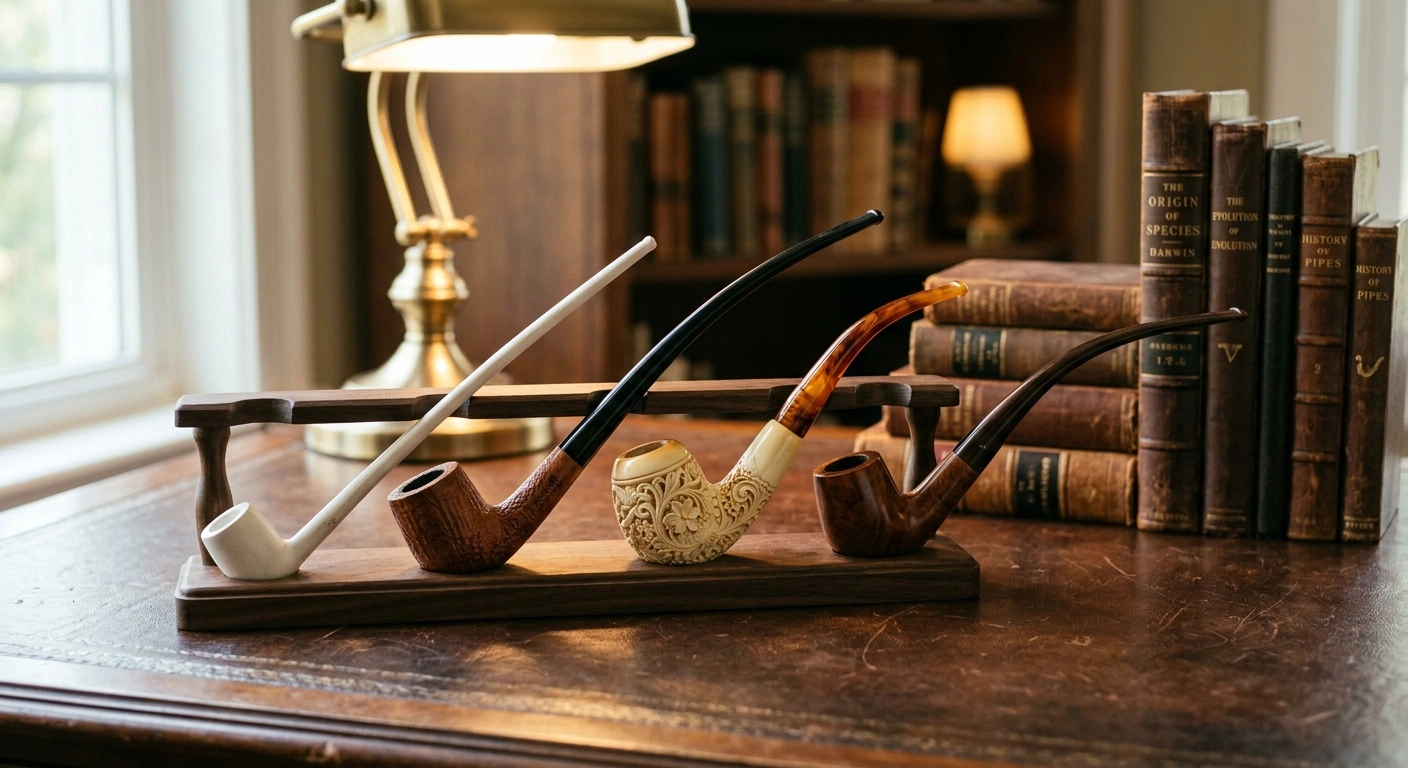
Churchwarden pipes stand out for their long, slender stems and measured, old-world profile. The name describes a general form, not a fixed bowl shape. Makers pair the extended stem with billiard, Dublin, apple, egg, and freehand bowls. Most examples suit quiet, seated smoking better than walking or working.
Early makers often formed the entire pipe from clay. Later versions combined long stems with briar, meerschaum, corncob, and other bowl materials. The added distance can make smoke feel cooler at the mouth. However, tobacco moisture, packing, and smoking cadence have a greater effect than stem length alone.
The form’s history combines documented pipe-making traditions with persistent folklore. Some familiar origin stories therefore deserve cautious treatment. The visual idea has remained consistent: a compact ember, a long line in the hand, and an unhurried pace.
The History of Churchwarden Pipes Before the Modern Name
Europeans smoked long-stemmed clay pipes before “churchwarden” became the common name for the style. Clay was inexpensive, easy to mold, and resistant to burning. These qualities made it a leading pipe material during the early centuries of European tobacco use.
Some clay pipes had short, practical stems. Others used considerable length for social, ceremonial, or fashionable reasons. A long stem moved the smoker’s face farther from the hot bowl. Clean clay also contributed relatively little flavor to the tobacco.
Fragility remained a serious drawback. Archaeologists often find broken clay stems rather than complete pipes. Even a modest knock could snap a thin stem.
The name’s precise origin remains uncertain. Stories link it to church officials, guards, tavern keepers, and smokers passing stems through windows. Historians cannot confirm any one story as the definitive explanation.
A persistent tale describes churchwardens smoking long pipes while guarding church property. Readers should treat that account as folklore rather than settled fact. Trade usage, regional language, and popular imagery often shape pipe names over time. The safest conclusion is that long clay pipes came first and the modern category name followed.
Clay and the Long-Stemmed Foundation
A traditional clay example could form one continuous piece. The bowl, shank, and stem created a narrow ceramic airway. Makers shaped specialized clay, dried it, and fired it to withstand normal smoking temperatures.
Clay absorbs less flavor than briar. As a result, a clean pipe presents tobacco with little contribution from the bowl material. However, clay transfers heat quickly. Aggressive puffing can make the bowl too hot to hold.
Many makers added a nub or spur beneath the bowl. This feature gave smokers a safer place to grip the pipe. It also reduced direct contact with the hot bowl.
The long airway gave smoke more distance to travel before reaching the mouth. It also created the pipe’s greatest weakness. A thin, fired-clay stem could break after a small impact or careless storage.
Narrow bores collect moisture, tobacco particles, and tar, especially during fast smoking. Historic smokers sometimes treated plain clay pipes as inexpensive or semi-disposable goods. More elaborate pieces featured detailed molding, polished surfaces, or decorative bowls.
Modern reproductions retain clay’s direct smoking character and historical appearance. They still demand deliberate handling. These pipes suit smokers who value neutral flavor and traditional construction over portability.
How Briar Changed the Form
Briar gave the long-stemmed style a tougher bowl and a warmer visual character. Makers cut briar from the root burl of tree heath. This dense, heat-resistant wood handles repeated smoking well after proper curing and drilling.
An all-clay pipe uses a continuous ceramic structure. In contrast, a briar model usually has a separate stem fitted into a wooden shank. Makers commonly choose vulcanite, acrylic, or another stable material for the stem.
Some pipes use one continuous mouthpiece. Others gain length through bamboo, horn, wood, or synthetic extensions. In either case, clean airway alignment matters more than decoration.
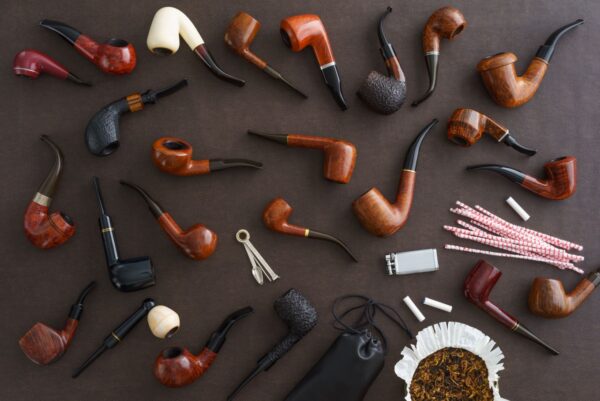
Briar also expanded the available range of bowl shapes. Makers adapted billiards, Dublins, apples, eggs, and bent bowls without losing the long silhouette. Grain and finish became important visual features.
Straight grain, flame grain, and birdseye can give the bowl distinct character. Sandblasting and rustication add texture while concealing minor surface flaws. Dark briar with a black stem remains a familiar combination. Lighter stains reveal more of the wood’s grain.
Briar handles ordinary use better than clay. Still, the extended stem increases leverage at the mortise. A fall or careless lift can crack the shank even when the bowl survives.
Regional Forms and Related Long Pipes
The churchwarden belongs to a wider family of European long pipes. Central European makers produced elaborate designs using porcelain, wood, horn, metal, and flexible sections. Some also added detachable reservoirs, windcaps, and moisture traps.
German, Austrian, Hungarian, and Tyrolean-associated pipes may have long or articulated stems. However, modern retailers do not classify every one of these forms as a churchwarden. Their bowls may hang below the mouthpiece or connect through several components.
Ottoman and Balkan traditions also included long-stemmed pipes. Many paired separate bowls with long wooden mouthpieces. The chibouk offers an important example, but it has its own construction and cultural history.
Calling every long pipe a churchwarden removes useful distinctions. Modern examples usually present a unified Western profile. A conventional bowl leads into one exceptionally long stem.
Collectors should examine more than overall length. Bowl form, fittings, airway design, and regional context provide better evidence. A long stem represents a shared design idea, not a single tradition.
Romanticism, Literature, and the Stage
Over time, long pipes gained associations with scholarship, contemplation, folklore, and rural life. Their extended lines worked well in paintings, illustrations, theater, and film. Audiences could read the silhouette easily from a distance.
Costume designers used the shape to suggest an earlier period without additional explanation. This cultural role helped preserve churchwarden pipes as compact briars became more convenient for daily use.
Popular memory also connects curved long pipes with detectives, wizards, and old-country storytellers. Sherlock Holmes provides a well-known example. Stage productions, films, and illustrations strengthened the curved-pipe image beyond the original stories.
Large curved pipes remained visible onstage and could leave an actor’s speech relatively unobstructed. Later fantasy art borrowed the same visual language. The shape came to suggest patience, age, and reflection.
These associations introduced the form to people outside pipe-smoking circles. They also encouraged the production of novelty pipes. A dramatic appearance does not guarantee good drilling, balance, or durability.
Churchwarden Materials and Their Characteristics
Modern makers use several bowl and stem materials. Each choice changes weight, heat transfer, flavor contribution, and maintenance. Construction quality still matters as much as the material itself.
Briar remains a practical choice for regular use. It combines heat resistance, moderate weight, and repairable traditional construction. A well-made briar bowl can provide years of service with proper care.
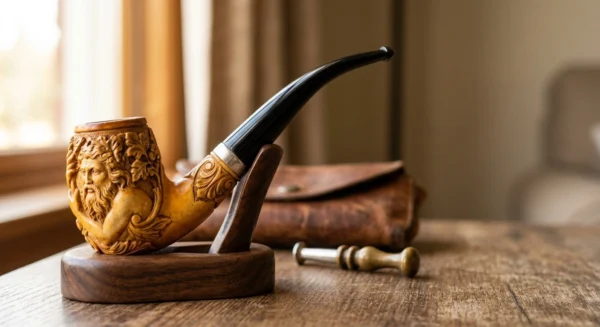
Meerschaum offers a dry, relatively neutral smoke and develops color with use. Long meerschaum pipes require careful handling, particularly around the fittings. Thick cake can also place damaging pressure on the chamber walls.
Clay provides historical authenticity and a direct tobacco taste. The bowl becomes hot, and the stem breaks easily. Secure storage and careful handling are essential.
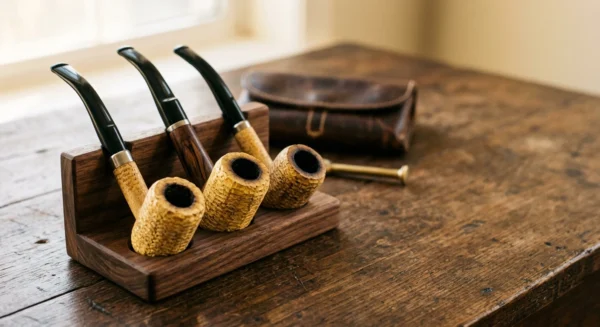
Corncob versions feel light and approachable. Their mild initial cob character usually fades with use. Inexpensive fittings may wear faster than those on a quality briar pipe.
Some artisans use morta or hardwood for bowls and extensions. Buyers should confirm which material forms or lines the tobacco chamber. Not every decorative wood can safely withstand direct combustion.
Stem material affects comfort and maintenance. Vulcanite feels softer against the teeth but oxidizes with exposure to light and air. Acrylic resists discoloration and takes a bright polish, though it feels harder.
| Material | Typical smoking character | Durability | Care considerations |
|---|---|---|---|
| Briar | Moderate bowl heat with a subtle wood character | Good, although the long stem and mortise remain vulnerable | Rest between smokes, control cake, and clean the complete airway |
| Clay | Neutral and direct, with a hot exterior bowl | Low resistance to impact | Use the intended grip point and store the pipe securely |
| Meerschaum | Dry and relatively neutral, with gradual color development | Moderate to fragile, depending on construction | Avoid knocks, thick cake, and stress around the stem fitting |
| Corncob | Light, mild, and easy-smoking after the initial cob note fades | Serviceable but usually less permanent than quality briar | Let the pipe dry fully and avoid soaking the shank |
What the Long Stem Actually Does
A long stem gives smoke more distance to travel before it reaches the mouth. Some heat can dissipate during that journey. Consequently, the smoke may feel cooler at the bit.
Stem length cannot correct hot combustion in the bowl. Wet tobacco, tight packing, and rapid puffing can still create steam and tongue irritation. They can also overheat the bowl.
Pipe and cigar smoking carry serious health risks. These include cancers of the mouth, throat, and lungs. The risks remain even if the smoker does not inhale.
The extended airway provides more surface for condensation. Therefore, a long pipe may gurgle despite its cool-smoking reputation. Moist aromatic tobacco and a fast cadence often increase that problem.
Good drilling allows a cleaner to pass through most or all of the airway. Sharply bent models may require cleaning after stem removal. Always let the pipe cool completely before separating the stem and shank.
A long stem can slightly soften a blend’s immediate intensity. It does not purify smoke or remove health risks. Its clearest effects involve distance, balance, condensation, and handling pace.
Shape, Bend, and Proportion
Early clay pipes often used straight or gently curved stems. Clay molding favored simple, continuous forms. Briar later allowed fuller bends, thicker shanks, ferrules, and more substantial transitions.
A straight model creates a clean visual line. However, the bowl places more leverage on the smoker’s hand and teeth. Most smokers need to support it rather than clench it.
A bent pipe hangs more naturally. The added curve can complicate cleaning and create a low point where moisture collects. Careful drilling helps limit these issues.
Bowl size strongly affects balance. A large bowl on a thin stem may look dramatic but feel tiring. A tiny bowl can make a thick mouthpiece appear heavy and awkward.
Good proportions distribute visual and physical weight through the shank and stem. Poor designs simply attach an oversized mouthpiece to an ordinary bowl. Length alone does not create a balanced pipe.
Bamboo, horn, wood, and metal accents can divide the long line and reinforce transitions. Buyers should inspect each joint closely. Fit, airway alignment, and structural strength matter more than ornament.
Factory-Made and Handmade Pipes
Factory production made the style available in consistent shapes and price ranges. Many factories fit extended stems to established briar bowl designs. These pipes can perform well when the drilling and balance are sound.
Entry-level models may use simple finishes, filled briar, or molded stems. Those features do not automatically prevent a good smoke. Clean engineering remains the deciding factor.
Mid-range pipes often receive more attention to shaping, stem fit, and finishing. High-end artisans may select each block and cut each stem by hand. Individual work can improve comfort, but reputation alone does not guarantee performance.
Stem work deserves close inspection on any handmade example. Small inaccuracies become more obvious across a long mouthpiece. The airway should run smoothly without abrupt ledges or narrow restrictions.
The draft hole should meet the tobacco chamber near its bottom center. The button should feel comfortable and allow an open draw. A tenon should seat firmly without excessive force.
Inspect the shank-to-stem junction from several angles. The surfaces should meet cleanly without obvious gaps or steps. Decorative extensions also need tidy joints and accurate airway alignment.
Attractive grain can increase visual appeal and collector interest. However, drilling and stem geometry influence daily use more directly. Choose sound construction before perfect grain.
Buying an Estate Churchwarden
An estate pipe can offer older materials and skilled workmanship. Its length also creates extra inspection points. Sight along the stem to find warping, cracks, repairs, and heavy tooth wear.
Examine the button for thinning or distortion. Then inspect the shank for hairline splits around the mortise. A long stem can exert considerable leverage in that area.
A replacement stem does not necessarily reduce smoking quality. Good fit and accurate drilling matter most for use. However, collectors may value an original stem more highly, so sellers should disclose replacements.
Inside the bowl, check for deep fissures, burnout, or an uneven chamber. Heavy cake can conceal damage. Ask the seller for photographs after careful reaming when possible.
Strong residual aromas may indicate ghosting from flavored or smoky blends. Thorough cleaning can often reduce these odors, though some remain persistent. Consider the previous tobacco use before buying.
Request exact measurements for online purchases. Photographs can exaggerate stem length or hide a very small chamber. Weight, overall length, chamber depth, and bowl diameter help clarify the pipe’s scale.
Documentation, original cases, and clear maker marks can support collector value. Doubtful or unreadable marks do not prove origin. Compare them with reliable maker records before accepting an attribution.
Using and Caring for a Churchwarden
This pipe works best at a desk, in an armchair, or on a sheltered porch. The smoker needs enough room to support the bowl safely. Crowded spaces create more chances for impact.
A long stem becomes inconvenient inside a small vehicle or near busy walkways. It can catch on clothing, furniture, and bags. A fitted case offers better travel protection than a standard pipe pouch.
At home, use a stable rack that supports both the bowl and stem. Keep the mouthpiece away from walkways and table edges. Never let the stem carry the bowl’s weight unsupported.
Cleaning requires extra-long pipe cleaners. Avoid joining cleaners if the connection could separate inside the airway. A lodged fragment can be difficult to remove.
After smoking, let the pipe cool before running a cleaner through the stem. Give accumulated moisture time to dry before the next use. Regular drying helps control sour odors and gurgling.
Remove the stem only after the pipe cools completely. Turn it gently instead of rocking it from side to side. Sideways pressure can loosen the mortise or crack the shank.
Keep cake thin and even in a briar bowl. Avoid substantial cake in clay or meerschaum because expansion can damage the chamber. Use tools carefully and remove material in small amounts.
Deep cleaning sometimes involves alcohol. Work with good ventilation and keep all solvents away from flames. Never mix cleaning chemicals.
Protect finishes, adhesives, and sensitive materials from solvent contact. Acrylic, meerschaum, decorative inlays, and exterior stains may react differently. Check the maker’s guidance before applying any liquid.
Fire safety remains essential. Never leave a lit pipe unattended, and use a stable ashtray. Extinguish the ash fully before emptying the bowl.
Follow local smoke-free laws and ask permission before smoking around other adults. Never smoke around children or pregnant people. Secondhand smoke exposes others to harmful chemicals.
The long stem can make the hot bowl’s position easy to misjudge. Keep it clear of curtains, books, clothing, and other combustible materials. Set the pipe down before reaching across a table.
Why the Long-Stemmed Form Endures
The form’s limitations remain closely tied to its appeal. It is harder to clean, difficult to clench, and less portable than a short pipe. Long stems also demand careful storage.
Those same proportions encourage the smoker to sit, support the bowl, and monitor cadence. Slower puffing often produces a calmer smoke. The benefit comes from controlled combustion, not a mysterious property of the shape.
Clay, briar, meerschaum, and corncob versions now serve different budgets and preferences. The design reflects European craft, theatrical imagery, literature, and modern artisan work. Yet it has never become one rigid shape.
Judge churchwarden pipes by the same standards as any well-made smoking pipe. Look for suitable materials, centered drilling, secure fittings, and a comfortable bit. Balanced proportions should also make sense in the hand.
A sound example offers more than costume appeal. Its length changes the handling, cleaning, and rhythm of a smoke. The enduring drama of the silhouette remains part of its character.